Queen of the Night: Rediscovering the Celtic Moon Goddess by NicMhacha Sharynne MacLeod
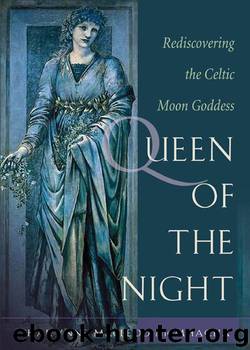
Author:NicMhacha, Sharynne MacLeod [NicMhacha, Sharynne MacLeod]
Language: eng
Format: azw3
ISBN: 9781609255770
Publisher: Red Wheel Weiser
Published: 2004-11-30T16:00:00+00:00
An Ancient Division of Space and Time
In Celtic Heritage, Alwyn and Brinley Rees write extensively about the two-fold division of space and time.32 Some of the earliest traditions pertaining to the division of the land of Ireland show it as conceptually divided into two halves, north and south. While both halves were significant, the north generally took precedence, which may be a parallel with the deference shown to the dark half of the year. The north was symbolically associated with kingship, dignity, and learning, and the south with music, food production, and “those who serve.” These are conceptual rather than political associations or divisions, and both halves contain important and complementary attributes.
Later, a secondary development took place, and the land was divided in two once again, making a total of four provinces, with the addition of a sacred central point or province.33 At this stage, new sets of attributes became associated with the four provinces, as well as with the center. In the Irish tale The Settling of the Manor of Tara, a list of about twenty attributes are mentioned as being associated with the various provinces. The primary attributes of each province or direction, however, are as follows: battle in the north, music in the south, prosperity in the east, learning in the west, and sovereignty in the center.
In addition, the medieval Irish text Saltair na Rann records that certain “winds” existed that were connected with each of the directions and associated with various colors. There were four winds in each of the main cardinal directions, with two winds between each of these.34 The colors associated with the four primary winds were: north (black or dark), south (white or shining), east (purple; in other contexts, red or a reddish-purple), and west (dun, a light yellowish brown, yellow in other traditions). The use of these four colors (black, white, red, and yellow) is ancient in origin and found in primal and indigenous artwork worldwide. In addition, these are the first four colors that receive a name in many languages (black and white are named first, followed by red, and then yellow or green).35
A similar evolution seems to have taken place in connection with the division of sacred time. Samain and Beltaine, the two most prominent Celtic feast days, may have been the earliest sacred days in the original two-fold division of the year. Imbolc and Lugnasad may have been introduced to the tradition later. Evidence for the early observance of Imbolc is scarce, and stories associated with the god Lug and the festival of Lugnasad suggest that this holiday may have been added later, perhaps to complement the addition of Imbolc.36
The early two-fold division of time was expressed on three different levels in the Coligny Calendar in relation to the month, year, and five-year cycles. The division of the lunar month into two halves (mat and anm) presents some interesting challenges.
Each lunar month was made up of two parts, the first half consisting of fifteen days, and the second half of either fourteen or fifteen days (depending on the type of month).
Download
This site does not store any files on its server. We only index and link to content provided by other sites. Please contact the content providers to delete copyright contents if any and email us, we'll remove relevant links or contents immediately.
| Paganism | Wicca |
| Witchcraft |
Becoming Supernatural by Dr. Joe Dispenza(8204)
Crystal Healing for Women by Mariah K. Lyons(7928)
The Witchcraft of Salem Village by Shirley Jackson(7257)
Inner Engineering: A Yogi's Guide to Joy by Sadhguru(6785)
The Four Agreements by Don Miguel Ruiz(6746)
The Power of Now: A Guide to Spiritual Enlightenment by Eckhart Tolle(5761)
Secrets of Antigravity Propulsion: Tesla, UFOs, and Classified Aerospace Technology by Ph.D. Paul A. Laviolette(5369)
The Wisdom of Sundays by Oprah Winfrey(5153)
Room 212 by Kate Stewart(5105)
Pale Blue Dot by Carl Sagan(4996)
Fear by Osho(4728)
The David Icke Guide to the Global Conspiracy (and how to end it) by David Icke(4709)
Animal Frequency by Melissa Alvarez(4463)
Rising Strong by Brene Brown(4451)
How to Change Your Mind by Michael Pollan(4355)
Sigil Witchery by Laura Tempest Zakroff(4238)
Man and His Symbols by Carl Gustav Jung(4131)
The Art of Happiness by The Dalai Lama(4125)
Real Magic by Dean Radin PhD(4121)
